
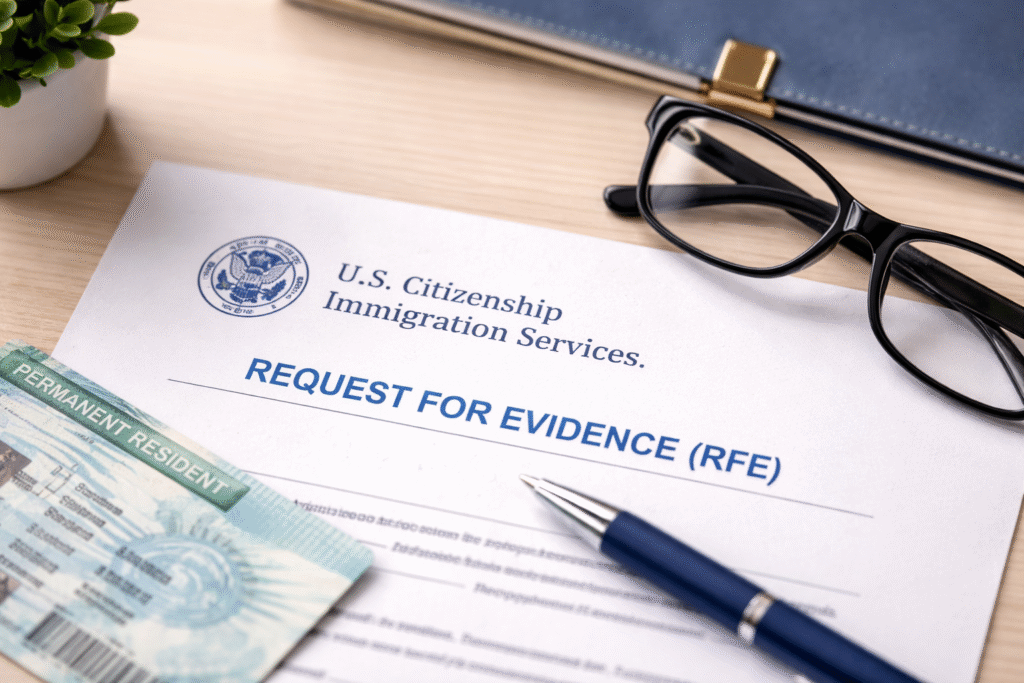
Receiving a Green Card RFE can be unsettling. Many applicants immediately fear the worst, assuming their application has been denied or that something has gone seriously wrong. In reality, a Request for Evidence (RFE) is a common and routine part of the USCIS review process, and in many cases, it simply means an immigration officer needs more information before making a final decision. It is not a rejection, and it does not automatically put your Green Card application at risk.
USCIS issues RFEs when documents are missing, unclear, incomplete, or insufficient to fully establish eligibility. This can happen even when applicants believe they submitted everything correctly. From I-485 adjustment of status cases to marriage-based and employment-based Green Card applications, RFEs affect thousands of applicants each year, and many of those cases are approved once the requested evidence is provided properly and on time.
Understanding how to read and respond to an RFE is critical. A strong, well-organized response can clarify questions, correct issues, and significantly improve your chances of approval, while a rushed or incomplete response can lead to unnecessary delays or even denial.
This guide explains what a Green Card RFE means, why USCIS issues RFEs, and how to respond correctly. Youwill also find practical examples, common mistakes to avoid, and guidance on when professional support is beneficial, so you can protect your case and move forward with confidence.
What Is a Green Card RFE?
A Green Card RFE is an official notice issued by U.S. Citizenship and Immigration Services (USCIS) requesting additional documents, clarification, or corrections related to your Green Card application.
USCIS issues an RFE when:
- Required evidence is missing
- Submitted documents are unclear or insufficient
- There are inconsistencies between forms or supporting records
An RFE is not a denial. It means USCIS cannot yet approve the case based on what was submitted and needs more information to complete its review.
Common Green Card applications that receive RFEs include:
Common Reasons USCIS Issues Green Card RFEs
Below are the most common reasons applicants receive an I-485 RFE or other Green Card RFEs.
1. Missing Required Initial Evidence
Examples include:
- Birth certificate not submitted, improperly translated, or missing required details
- Marriage certificate missing or unreadable
- Divorce decrees or annulment records from prior marriages are not included
USCIS requires specific formats and supporting details. Submitting a document alone may not be enough if it does not meet USCIS standards.
2. Insufficient Financial Sponsorship Evidence
RFEs related to Form I-864 (Affidavit of Support) are extremely common.
USCIS may issue an RFE when:
- Reported income does not meet the required guidelines
- IRS tax transcripts are missing or incomplete
- Employer letters or pay stubs are outdated
- Joint sponsor documentation is insufficient or improperly prepared
In some cases, assets may help address income shortfalls, but only if documented correctly.
3. Relationship Evidence Concerns (Marriage-Based RFEs)
In marriage-based Green Card cases, USCIS must confirm the marriage was entered into in good faith, not solely for immigration benefits.
Common RFE triggers include:
- Limited joint financial records
- Recently opened joint accounts
- Few shared documents
- Short marriage duration
- Cultural or practical reasons for keeping finances separate
A lack of traditional documents does not automatically mean a denial, but it often leads to an RFE requesting stronger proof.
4. Medical Exam or Background Issues
Medical-related RFEs often involve:
- Expired Form I-693
- Missing vaccination records
- Incomplete civil surgeon signatures or dates
USCIS requires a properly completed and sealed medical exam from an approved civil surgeon.
5. Errors or Inconsistencies in Forms
Examples include:
- Different addresses listed across forms
- Name spelling differences
- Conflicting dates of entry or employment history
Even small discrepancies can trigger an RFE if they raise questions about accuracy or eligibility.
How to Read and Interpret a Green Card RFE Notice
Every RFE notice contains critical instructions. Reading it carefully is essential.
A typical RFE includes:
- The exact evidence USCIS is requesting
- A strict response deadline (usually 30–90 days)
- Instructions on how and where to submit your response
- An RFE cover sheet, which must be included
Example of USCIS RFE Language: “The evidence submitted does not establish that the petitioner meets the income requirements. Please submit additional evidence to demonstrate eligibility.”
This language means USCIS wants more or stronger proof, not a general explanation or argument.
Common Green Card RFE Mistakes to Avoid
Many denials occur not because of eligibility issues, but because of avoidable mistakes.
Avoid:
- Sending far more documents than requested
- Submitting explanations without supporting evidence
- Ignoring formatting, labeling, or translation requirements
- Waiting until the final days to prepare the response
- Re-submitting the same evidence that triggered the RFE
An RFE response should be strategic, not rushed or overstuffed.
Why a Strategic RFE Response Matters
A Green Card RFE is more than a request for missing paperwork, it is a direct signal from USCIS identifying where your application falls short of their legal or evidentiary standards. How you respond to an RFE often determines whether your application moves forward or is denied.
At this stage, USCIS has already reviewed your case and flagged specific concerns. The RFE tells you what is preventing approval, even if the language used is formal or indirect. A strategic response focuses on resolving those concerns clearly and decisively, rather than simply sending more documents.
A well-prepared RFE response is strategic because it:
Focuses only on the evidence USCIS requested
Submitting unnecessary or unrelated documents can distract from the core issue and create new questions. A strategic response addresses each request precisely, without overwhelming the officer reviewing the case.Clearly ties every document back to eligibility requirements
Evidence should not stand on its own. Each document should clearly support the legal requirement USCIS is evaluating—such as financial sponsorship, relationship validity, or lawful entry—making it easy for the officer to see how eligibility is established.Anticipates follow-up questions an officer may raise
A strategic response goes one step further by filling in obvious gaps. For example, if USCIS questions income stability, submitting consistent tax records alongside employment verification can help prevent additional scrutiny.Presents information in a clear, organized, and persuasive manner
Organization matters. Clearly labeled documents, logical sequencing, and concise explanations help USCIS review your response efficiently and reduce the risk of misunderstanding or oversight.
Because USCIS often makes a final decision based largely or entirely on the RFE response, this stage is frequently the last meaningful opportunity to correct issues in a pending application. Unlike the initial filing, there may be no further chance to explain or supplement your case if the response is deemed insufficient. Taking a strategic approach at this point can mean the difference between approval and denial, making careful preparation, accuracy, and clarity especially critical.
How to Respond to a Green Card RFE (Step-by-Step)
Step 1: Identify Every Requested Item
Carefully review the notice and highlight each specific request. Missing even one item can lead to denial.
Step 2: Gather Targeted Evidence
Submit only documents that directly respond to USCIS’s request. Avoid unnecessary or unrelated records.
Step 3: Prepare a Clear, Organized Response Packet
Your response should include:
- The RFE notice on top
- A brief cover letter or table of contents
- Clearly labeled evidence sections
Organization helps the officer quickly verify that each request has been addressed.
Step 4: Submit Before the Deadline
USCIS does not grant extensions for RFEs.
A late response may result in automatic denial, regardless of case strength.
Real-World Green Card RFE Examples
Example 1: Marriage-Based I-485 RFE
USCIS Request:
“Submit additional evidence to establish that your marriage was entered into in good faith.”
Strong Response May Include:
- Joint lease or mortgage covering an extended period
- Shared utility bills
- Joint bank or credit card statements over time
- Photos from different life events
- Affidavits from family or friends with personal knowledge
Example 2: Financial Sponsorship RFE
USCIS Request:
“The submitted Form I-864 does not establish sufficient income.”
Appropriate Response May Include:
- Most recent IRS tax transcript
- Employer verification letter
- Recent pay stubs
- Joint sponsor documents, if applicable
Example 3: Medical Exam RFE
USCIS Request:
“Submit a completed Form I-693.”
Correct Response:
- A new, sealed Form I-693
- Completed by a USCIS-approved civil surgeon
Proper signatures and valid dates
RFE vs. NOID: What’s the Difference?
| Green Card RFE | NOID (Notice of Intent to Deny) |
|---|---|
| Requests more evidence | Indicates USCIS believes eligibility may not be met |
| Very common | Less common |
| Case remains open | Higher legal risk |
| Often resolved with strong evidence | Typically requires legal assistance |
What Happens After You Respond to an RFE?
Once USCIS receives your RFE response, your application is placed back into active review. An immigration officer will reassess your case alongside the additional evidence you submitted to determine whether the issue raised in the RFE has been resolved.
For example, if USCIS requested additional proof of income, the officer will review your newly submitted tax transcripts, pay stubs, or joint sponsor documents to confirm that financial requirements are met. If the RFE concerned a marriage-based I-485, the officer may focus on whether the added joint documents clearly establish a bona fide relationship.
Processing times after an RFE response can range from a few weeks to several months, depending on the complexity of the request, the type of Green Card application, and USCIS workload.
After reviewing your response, USCIS may take one of the following actions:
-
Approval:
If the evidence fully satisfies USCIS’s request and confirms your eligibility, your Green Card application may be approved without any further action required from you. -
Additional Review or Further Requests:
In some cases, USCIS may continue reviewing your application or issue another request if more clarification is needed. While less common, this can happen when the submitted evidence partially addresses the concern but leaves remaining questions. -
Denial:
If the response is incomplete, submitted late, or fails to adequately address the issues raised in the RFE, USCIS may deny the application. This is why accuracy, organization, and relevance of evidence are critical.
You can monitor your case status using your USCIS receipt number. While waiting, it’s important to avoid submitting unsolicited documents unless specifically requested, as doing so can slow down processing or create confusion.
When a Lawyer Can Help With a Green Card RFE
If you’ve received a Green Card RFE and are unsure how to proceed, scheduling a review with an immigration professional early can help you understand what USCIS is truly requesting and how best to respond. While some RFEs involve straightforward document submissions, others are more complex and require careful interpretation of USCIS language and expectations.
The RFE language is unclear or highly technical, making it difficult to understand what USCIS is actually requesting
USCIS questions your eligibility, credibility, or compliance with immigration requirements
Your case involves prior denials, overstays, status violations, or immigration history issues
You are unsure what evidence is sufficient, relevant, or persuasive for USCIS purposes
In these situations, a misstep, such as submitting the wrong documents, providing incomplete evidence, or overloading your response with unnecessary information, can significantly increase the risk of delays or denial.
An experienced immigration attorney can help by:
Interpreting USCIS requests accurately, including identifying the real issue behind the RFE language
Evaluating the strength of your existing evidence and identifying gaps USCIS may still question
Guiding you on what to submit, and what not to submit, to avoid confusion or over-disclosure
Ensuring your response aligns with USCIS expectations and legal standards
A carefully reviewed RFE response often improves clarity, strengthens eligibility arguments, and reduces the likelihood of further requests or negative outcomes.
Get personalized guidance from an experienced green card lawyer.
Frequently Asked Questions
Is a Green Card RFE a bad sign?
No. Receiving a Green Card RFE does not mean your application will be denied. RFEs are a normal part of the USCIS review process and are often issued when an officer needs additional documents or clarification before approving a case. Many Green Card applications are approved after a complete and well-prepared RFE response is submitted.
How long do I have to respond to an RFE?
The response deadline is listed on your RFE notice, typically ranging from 30 to 90 days depending on the type of request. This deadline is strict. USCIS does not grant extensions, and failing to respond on time usually results in an automatic denial of the application.
What happens if I miss the RFE deadline?
If USCIS does not receive your response by the deadline, your application may be denied due to abandonment. Even if you have strong evidence, a late response is generally not accepted. This is why it’s important to begin preparing your response as soon as you receive the RFE.
Can I submit more documents than USCIS requested?
It is generally best to submit only the documents USCIS specifically requested. Sending excessive or unrelated documents can slow down processing and may create additional questions. If additional evidence is included, it should directly support the requested information.
Is an RFE the same as a NOID?
No. An RFE requests additional evidence, while a Notice of Intent to Deny (NOID) indicates USCIS plans to deny the application unless substantial evidence is provided. RFEs are far more common and generally less serious than NOIDs.
Can an RFE delay my Green Card process?
Yes. An RFE pauses processing until USCIS receives and reviews your response. While this can delay the timeline, responding accurately and promptly helps minimize further delays.
How long does USCIS take to decide after an RFE response?
There is no fixed timeline. Some applicants receive a decision within a few weeks, while others may wait several months. Processing times depend on the case type, complexity, and USCIS workload. Case status updates can be tracked using your receipt number.
Can I receive a second RFE?
While uncommon, USCIS may issue a second RFE if the initial response partially addresses the concern or raises new questions. This is why submitting a complete and well-organized response the first time is critical.
This information is for general educational purposes only and is not legal advice. Reading this page does not create an attorney–client relationship. Immigration laws change frequently, and your situation may require personalized guidance.
